

- By MuggleNet Editorial Staff
- 11 Aug, 2026
- Fandom
There are Harry Potter filming locations, and then there are places where the Wizarding World has acquired enough real-world importance to affect an actual multimillion-pound infrastructure project.
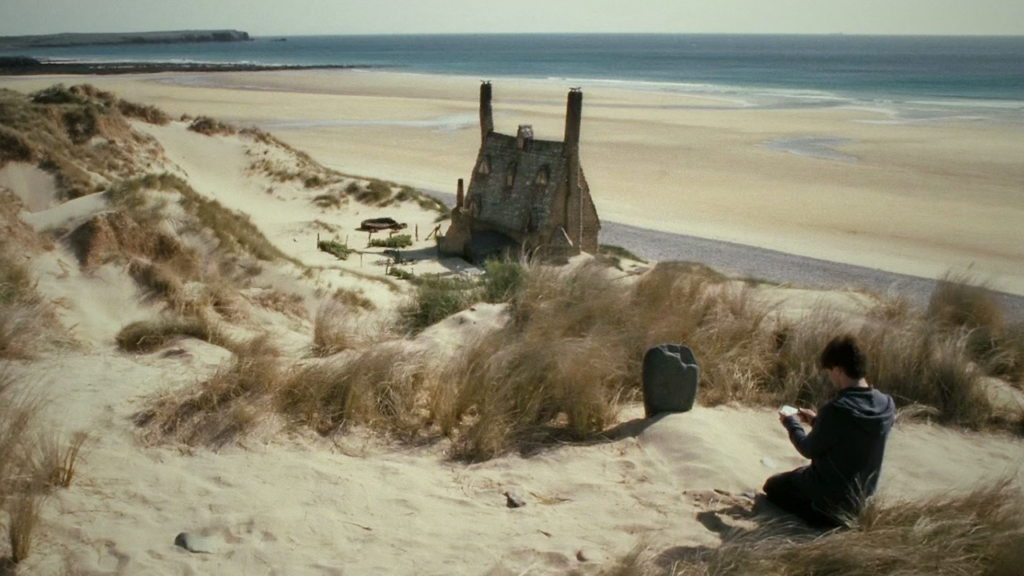
Freshwater West, the windswept beach in Pembrokeshire, Wales, where Dobby’s final scenes were filmed for Harry Potter and the Deathly Hallows, now belongs firmly in the second category.
Years ago, planners working on the Greenlink interconnector, a major electricity link between Ireland and Great Britain, altered part of the project’s planned route after the company was inundated with calls from people concerned that construction would disturb the unofficial memorial known as “Dobby’s grave.” The story has only now come fully to light, after former Greenlink project manager Simon Ludlam recounted it on the August 5 episode of The Energy Revolution podcast.
And while the headline understandably sounds like something somebody made up after one too many Firewhiskeys, the details offer a surprisingly interesting example of what happens when a fictional location becomes a real cultural landmark.

Ready to start the Harry Potter full-cast audiobooks?
First month free then $8.99/month
How Dobby Got in the Way of an Electricity Cable
Greenlink is a 500-megawatt electricity interconnector running roughly 190 kilometers between County Wexford, Ireland, and Pembrokeshire. The cable comes ashore at Freshwater West before ultimately connecting to the Pembroke substation. Construction started in 2022, and Greenlink became operational in February 2025.
The Dobby complication came considerably earlier.
Ludlam explained on The Energy Revolution that he had appeared in a BBC Wales segment filmed at Freshwater West, where he showed viewers roughly where the project would come onto land and continue underground. What he apparently did not realize was that the route he was describing intersected with a place that meant rather more to Harry Potter viewers than it did to the engineering team.
After the segment aired, calls began arriving, hundreds of them, according to Ludlam’s account. He initially did not even know who Dobby was. Once colleagues explained why people were objecting, however, the concern became something planners had to take seriously.
The route was reconsidered so that the project would stay clear of the memorial. Ludlam described the episode as a lesson in remaining responsive during enormous infrastructure projects: Sometimes the unexpected stakeholder in your electrical-grid planning turns out to be a dead house-elf. The £430 million figure attached to the project in current reports makes the whole thing sound even more unbelievable.
There is an important bit of context missing from a lot of the coverage, though. Greenlink didn’t simply dig a giant trench across the beach and move it several feet to the left because somebody called about Dobby. The final route was shaped by environmental, technical, planning and archaeological considerations, and the finished cables were installed beneath the beach and dunes using horizontal directional drilling. Greenlink says that method meant the beach itself did not need to be opened up for a trench.
Still, according to Ludlam, the Dobby memorial became one of the constraints planners took into account.
A Fictional Grave That Became a Real Place
There is another layer to the story that makes it particularly fascinating.
Dobby is not actually buried in Wales even within the fictional geography of Harry Potter. Shell Cottage is in Cornwall in the books, and the official Harry Potter encyclopedia still identifies Cornwall as its location. Freshwater West became Shell Cottage only for the films. The cottage itself was constructed there for filming and removed afterward.
Yet the emotional association survived after the set disappeared. Visitors began assembling stones and messages around the spot, gradually transforming an ordinary beach. That transformation has become significant enough that Dobby’s grave has now survived two entirely different threats.
The Greenlink controversy appears to date to the project-planning period around 2019. Then, in 2022, the question was not an electricity cable at all: It was whether the memorial itself had become too disruptive to Freshwater West.
A sustainability study commissioned as part of efforts to manage the beach found that the Harry Potter connection had attracted additional visitors and benefited local tourism but had also contributed to concerns about crowding and environmental pressure. The consultation received thousands of responses, and the numbers surrounding Dobby were striking. Roughly two-thirds of respondents were firmly opposed to removing the memorial; just 24% expressed some level of support for removal, while only 15% supported moving it to another accessible location away from the beach.
So Dobby’s grave remained.
Saving Dobby’s Grave Also Means Protecting Freshwater West
The memorial may have helped demonstrate how deeply Harry Potter locations matter to us, but some of the ways visitors have marked their affection have caused another problem.
Socks, trinkets and painted stones have all been left at the site over the years. At Freshwater West, though, an abandoned sock is still an abandoned piece of material sitting in a sensitive coastal environment.
National Trust Cymru asked visitors in 2022 to stop leaving objects at the memorial because material from those tributes could find its way into the surrounding ecosystem. The broader Freshwater West management study also makes clear that increasing visitor numbers have put pressure on the dunes, roads, parking and wildlife.
So, yes: Dobby’s grave survived the electricity cable. It survived a debate over whether it should remain on the beach. Nearly 16 years after audiences watched Harry dig into the sand by hand, people are still making sure that little patch of Welsh coastline is treated as something meaningful.
The best way to keep it there may now be the simplest one: Visit if you go, take your photos, remember Dobby… but maybe keep the socks on your feet.
About MuggleNet: MuggleNet has covered the Wizarding World since 1999, offering news, guides, editorials and fan resources for readers around the world.
Feature Image: Warner Brothers Discovery