

- By MuggleNet Editorial Staff
- 8 Jul, 2026
Official Wizarding World writing describes a ghost as the transparent, three-dimensional imprint of a deceased witch or wizard who remains in the mortal world rather than moving on. Ghosts in the Harry Potter series are not all-knowing spirits who have returned from some grand afterlife with answers. They are, in many ways, frozen. Their personalities, regrets, and habits remain much as they were at the time of death.
Before we meet them one by one, there are a few rules of the dead worth knowing.
Ghosts in the wizarding world can pass through solid objects, disturb water, fire and air, and bring a sharp drop in temperature when they move through a room. Being passed through by one feels like being plunged into icy water. Their presence can turn flames blue, and while they can be seen and heard clearly by witches and wizards, Muggles generally experience haunted places as cold or unsettling rather than seeing ghosts in perfect focus.
Ghosts also cannot tell us much about what comes after death. Nearly Headless Nick makes that painfully clear after Sirius Black’s death, when Harry wants answers about whether the people he loves can return. Nick can speak about choosing to remain behind, but not about what waits beyond. He did not go there.
A ghost is not a victory over death. It is a refusal or, perhaps more accurately, a hesitation. In the world of Harry Potter, the wisest witches and wizards choose to move on. Hogwarts, however, is full of those who did not.
Nearly Headless Nick
Nearly Headless Nick is the first Hogwarts ghost many of us get to know properly, and that is fitting. As Gryffindor’s house ghost, he is courtly, talkative, sensitive and silly enough to keep the castle from becoming too solemn.
His full name is Sir Nicholas de Mimsy-Porpington, and he very much prefers it. The nickname “Nearly Headless Nick” may be accurate, but it touches a sore spot that has followed him for centuries. Nick was executed on Oct. 31, 1492, after a magical mishap involving Lady Grieve, a member of the royal court. According to official Wizarding World background, Nick attempted to improve her appearance by magic and instead caused her to sprout tusks. His wand was taken, and his execution was badly botched, leaving his head attached by a small flap of skin and sinew.
Nick’s incomplete beheading becomes a major part of his identity. Among living students, he is a distinguished and occasionally helpful presence. Among fully headless ghosts, he is not quite enough. His rejected application to the Headless Hunt in Chamber of Secrets is played for comedy, but it is also a bit of a tragedy. Even in death, Nick wants acceptance from a social circle that sees him as insufficiently decapitated.
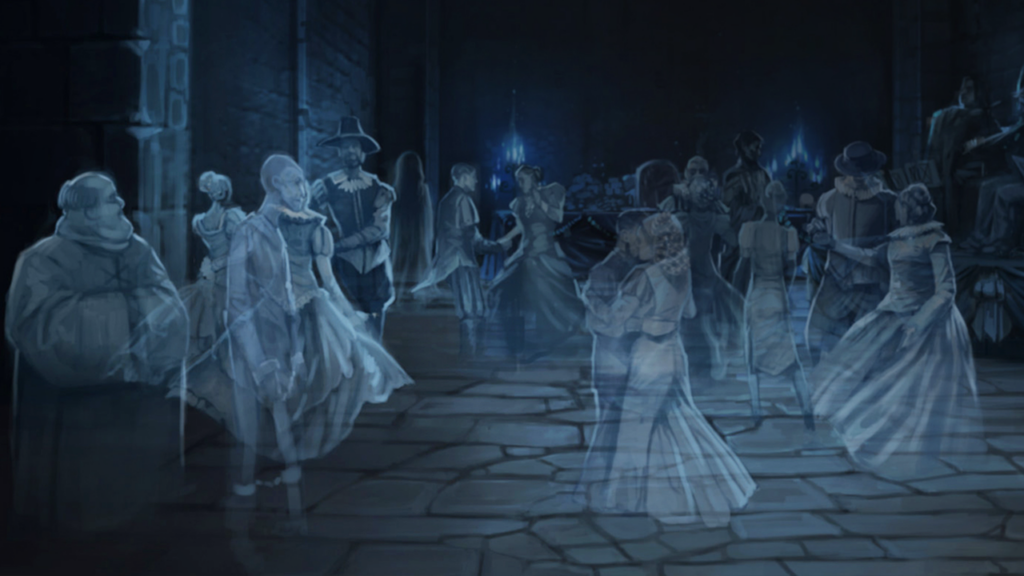
That insecurity does not stop him from being one of the warmer spirits at Hogwarts. Nick greets Harry at the start-of-term feast, tries to help him navigate castle life and, in Chamber of Secrets, provides one of the strangest invitations Harry ever receives: to his 500th deathday party. The party gives us our deepest look at ghost culture.
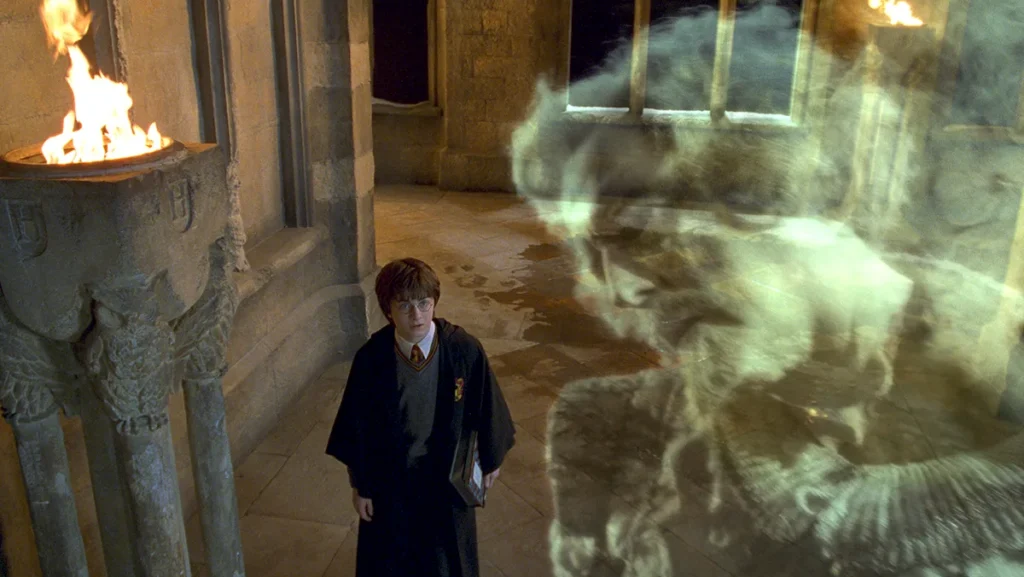
Nick also becomes unexpectedly important during the Chamber of Secrets attacks. When the Basilisk’s gaze is reflected through him, he is petrified rather than killed, because a ghost cannot die again.
His most emotionally important scene, though, comes in Order of the Phoenix. After Sirius dies, Harry desperately seeks Nick out, hoping ghosts might prove that death is not final. Nick’s answer is gentle but devastating. He explains that some wizards leave an imprint of themselves behind, but very few choose that path. He admits he was afraid of death.
For Gryffindor’s ghost, that is perhaps a bit unexpected. Nick belonged to the house known for bravery, yet his defining afterlife choice came from fear. That does not necessarily make him a failed Gryffindor. It makes him one of the series’s more honest portraits of courage: someone who can be kind, loyal and gallant while still carrying the consequences of the moment when he could not face the unknown.
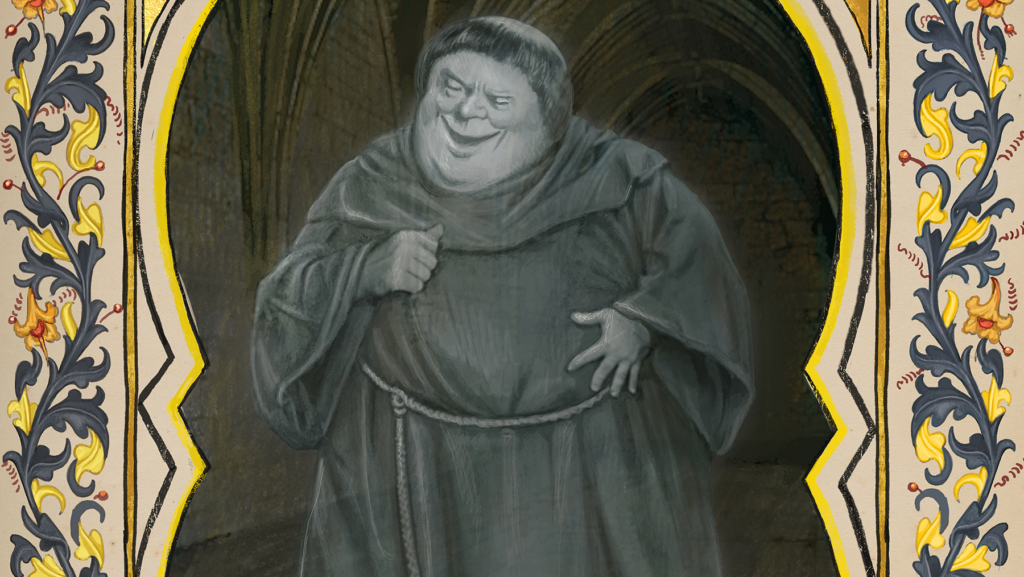
The Fat Friar
The Fat Friar is one of the most underused ghosts in the books, which is a shame because every detail we do get about him is delightful.
He is Hufflepuff’s house ghost, and he appears at Harry’s first Sorting as a cheerful, welcoming presence. While some Hogwarts ghosts seem chilly in every sense of the word, the Friar has an unmistakably generous spirit. He waves merrily, supports second chances and is the one ghost most likely to argue that Peeves should be forgiven.
Peeves drops things, smashes things, and insults people. Yet the Fat Friar still believes in mercy. In Philosopher’s Stone, when the ghosts debate whether Peeves should be allowed to attend the start-of-term feast, the Friar’s attitude is essentially, “Forgive and forget.” Very Hufflepuff. Perhaps too optimistic, but that is part of his charm.
His backstory is darker than his personality suggests. Official Wizarding World writing says he was executed after senior churchmen became suspicious of his ability to cure the pox by poking people with a stick. His habit of pulling rabbits from the Communion cup did not help matters. The detail is comic, but the implication is grim: The Friar’s magical kindness was misread as something dangerous by the nonmagical religious authorities around him.
There is also a small, wonderfully petty note in his characterization: He reportedly still resents never having been made a cardinal. That detail keeps him from becoming too saintly. The Friar may be kind, but he is still a ghost, and ghosts in Harry Potter tend to preserve old disappointments.
As Hufflepuff’s ghost, the Fat Friar represents some of the house’s best qualities: loyalty, fairness, patience and compassion. He seems less concerned with prestige than Nearly Headless Nick and less burdened by tragedy than the Gray Lady or Bloody Baron. Yet his story still reflects a recurring theme among the ghosts: A person’s death does not erase the social world that shaped them.
The Fat Friar is not central to the main plot, but he helps make Hogwarts feel like a real place with more history than Harry can ever fully learn.

Ready to start the Harry Potter full-cast audiobooks?
$0.99/month for 3 months then $8.99/month
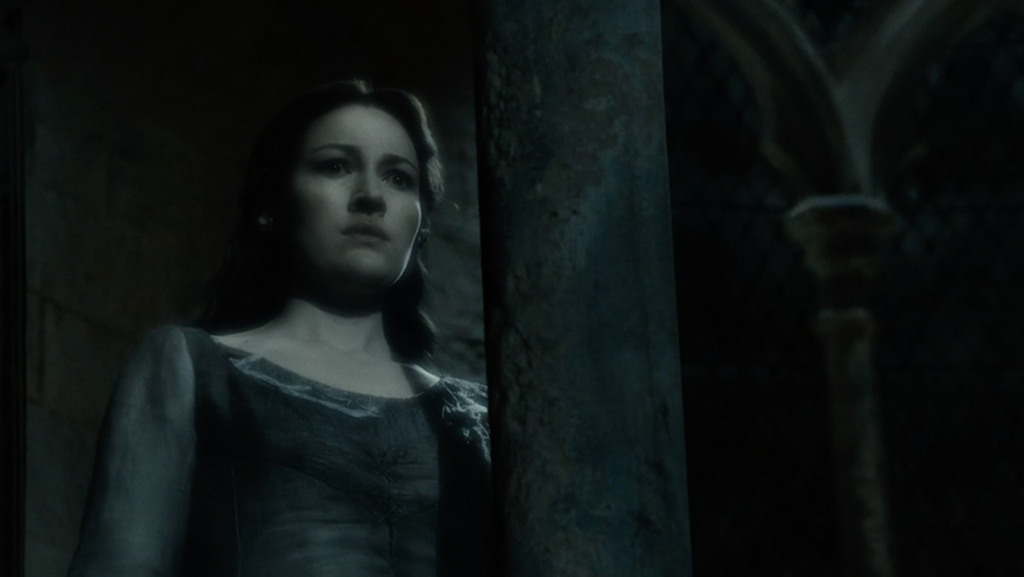
The Grey Lady
The Grey Lady is one of the quietest ghosts at Hogwarts. She is Ravenclaw’s ghost: long-haired, beautiful, distant and reluctant to speak. Students know of her, but few seem to know her.
Then Deathly Hallows reveals that she is not merely the Grey Lady. She is Helena Ravenclaw, daughter of Rowena Ravenclaw, one of the four founders of Hogwarts.
Helena’s tragedy begins with the diadem. Rowena Ravenclaw’s diadem was said to enhance the wisdom of the wearer, and Helena stole it from her mother. Helena wanted to make herself cleverer and more important than the mother whose fame overshadowed her. She fled to a forest in Albania and hid the diadem there.
When Rowena was dying, she wanted to see her daughter again and sent the Baron to bring Helena home. Helena refused. The Baron, enraged by her rejection and jealous of her freedom, murdered her. Horrified by what he had done, he then killed himself.
Helena hid the truth about the diadem for centuries. When Tom Riddle was a student, he charmed the story out of her and later found the diadem in Albania. He turned it into a Horcrux and eventually hid it in the Room of Requirement, bringing Helena’s old betrayal into the center of the final battle against Voldemort.
Her role also gives Ravenclaw one of its most complicated internal critiques. The house values intelligence, but Helena’s story asks what happens when intelligence becomes envy, when wisdom becomes an object to possess and when shame keeps the truth buried for too long. She is not villainized for wanting more than her mother’s shadow, but the story does not excuse what followed either.
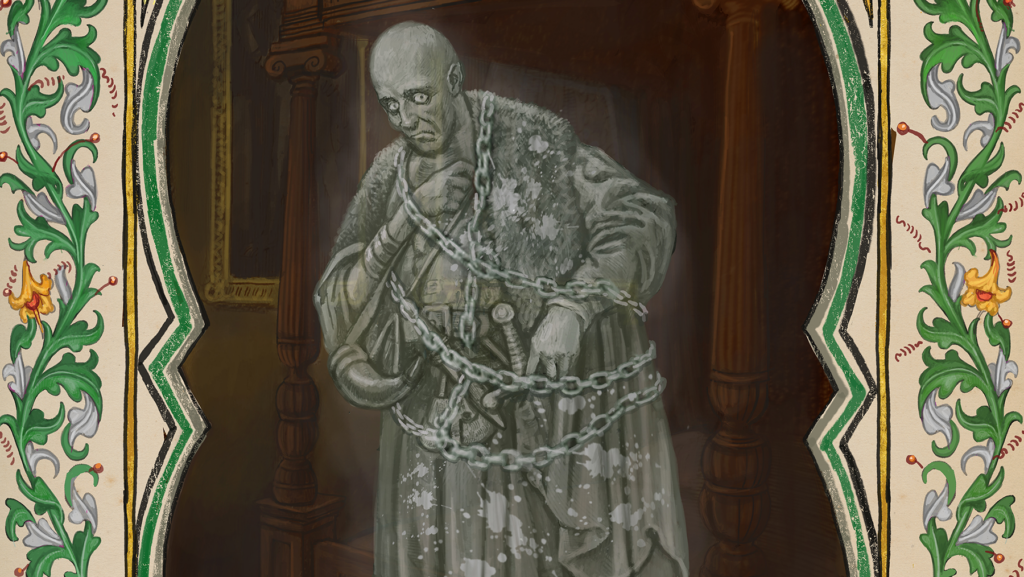
The Bloody Baron
The Bloody Baron may be the most frightening of the house ghosts, and unlike some of Hogwarts’s eerie reputations, his is deserved.
He is Slytherin’s ghost: gaunt, silent and covered in silver bloodstains. Students are afraid of him. Other ghosts treat him with caution. Peeves, who respects almost no one, obeys him. That alone tells us plenty. Anyone capable of controlling Peeves has either immense authority, immense menace or both.
For much of the series, the Bloody Baron is more presence than character. He appears as a grim visual note in the Great Hall, a reminder that Slytherin’s history is not all ambition and elegance. But Deathly Hallows ties his story directly to the Gray Lady’s, turning him from castle decoration into one half of Hogwarts’ oldest murder-suicide.
In life, he was simply the Baron, a man infatuated with Helena Ravenclaw. Rowena Ravenclaw sent him to find Helena after she fled with the diadem. When Helena refused to return, the Baron killed her. Overcome with remorse, he used the same weapon to kill himself. His bloodstained appearance and chains became a form of eternal penance.
It is an intensely dark story, and it is worth treating it as such. The Baron is not tragic because his love was unreturned. He is tragic because he turned entitlement into violence and remorse into self-destruction. His ghostly punishment does not undo the harm he caused Helena. It only ensures that he carries the evidence of it forever.
And yet, like many ghosts, he is not reduced to a single function. He has a role within the castle. He represents Slytherin House. He participates in the strange social order of Hogwarts’s dead. His presence at school feasts and among students means generation after generation grows up with a murderer as one of the castle’s accepted spirits.
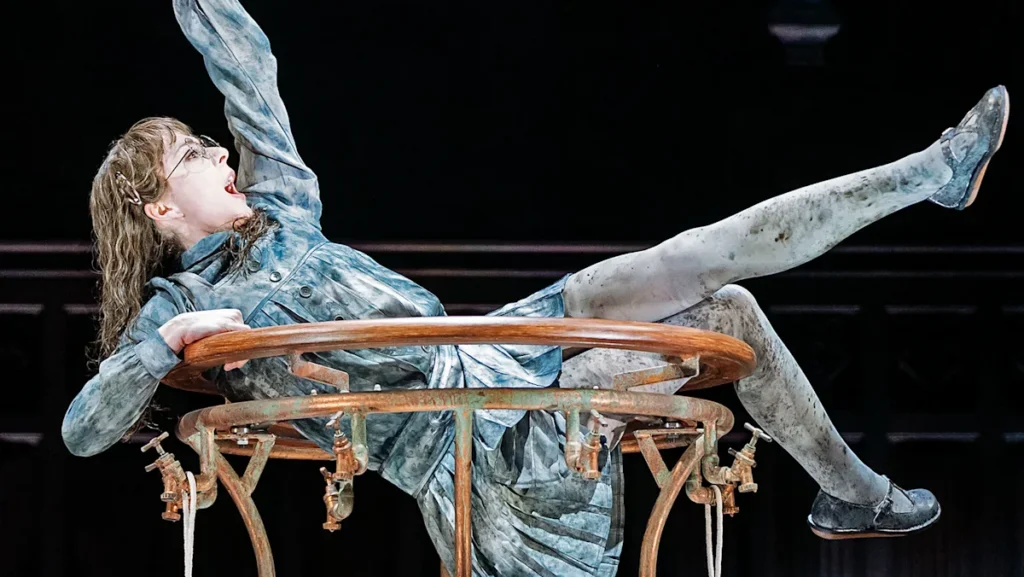
Moaning Myrtle
Moaning Myrtle is one of the most important ghosts in the series, and also one of the easiest to underestimate because she is written to be funny, awkward and deeply uncomfortable.
Her full name is Myrtle Elizabeth Warren. Before she became the ghost haunting a girls’ bathroom, she was a Ravenclaw student in the 1940s. She was lonely, bullied and especially tormented by Olive Hornby. After one such incident, Myrtle hid in the bathroom and cried. There, she heard a boy speaking in a strange language. That boy was Tom Riddle, opening the Chamber of Secrets.
When Myrtle opened the stall door, she saw the Basilisk and died instantly.
Her death is the first (known) murder in Tom Riddle’s path to becoming Lord Voldemort, and it sets off one of Hogwarts’s great cover-ups. Riddle frames Hagrid, Aragog becomes the convenient monster, and Myrtle becomes part of the school’s atmosphere: a sobbing, splashing, easily dismissed reminder of the crime no one solved properly.
After her death, Myrtle initially haunted Olive Hornby (who probably deserved it), making sure her former bully did not forget what had happened. Eventually, the Ministry of Magic intervened, and Myrtle was forced back to Hogwarts, where she took up residence in the bathroom that would become one of the most important locations in the series.
Myrtle matters to the plot again and again. In Chamber of Secrets, her bathroom hides the entrance to the Chamber itself. In Goblet of Fire, she helps Harry with the golden egg clue, creating one of the series’s most magnificently awkward bathroom scenes. In Half-Blood Prince, she becomes a confidante of sorts to Draco Malfoy, who cries in that same bathroom as he struggles with the task Voldemort has given him. In Cursed Child, she helps Albus and Scorpius get out of the castle through the pipes when Albus has been ordered to stay within its walls.
Myrtle’s ghosthood is also one of the series’s sharpest portraits of adolescence frozen in place. She died as a schoolgirl, and she remains one: emotional, defensive, attention-seeking, wounded and lonely. The books often make us laugh at her, but they also ask us to sit with the horror of what happened. Myrtle was a child murdered in a school bathroom, and then even in death, she was treated as an inconvenience.
Professor Cuthbert Binns
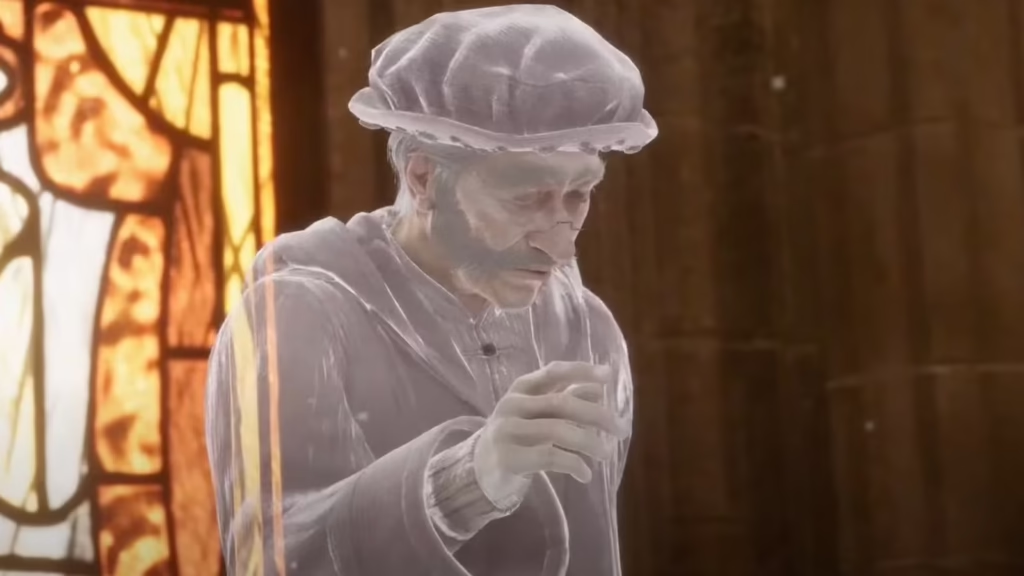
Professor Cuthbert Binns is proof that not every ghost at Hogwarts has a dramatic or tragic story. Some are simply very, very boring.
Binns teaches History of Magic, and according to official Wizarding World background, he died in perhaps the most Binns way imaginable: He fell asleep in front of the staffroom fire, got up the next day and went to teach, leaving his body behind. There is some debate over whether he even realizes he is dead.
That is funny, but it is also a perfect piece of character writing. Binns is so consumed by routine that death does not interrupt him. He continues teaching in the same flat, droning style, entering classrooms through the blackboard and reducing some of the most fascinating material in wizarding history to a blur of goblin rebellions and names students cannot remember.
Unlike the house ghosts, Binns has a formal institutional role, he is faculty. That makes him one of the strangest details in the Hogwarts staffing system. The school employs a dead man to teach history, and by all evidence, no one sees this as especially urgent to revisit.
From an academic point of view, Binns is fascinating because he represents the failure of history as mere recitation. He has access to centuries of knowledge, perhaps even firsthand memory of parts of it, but his teaching is lifeless in every sense. Students tune out. Important patterns vanish into monotony. The past becomes something to endure rather than understand.
Peeves
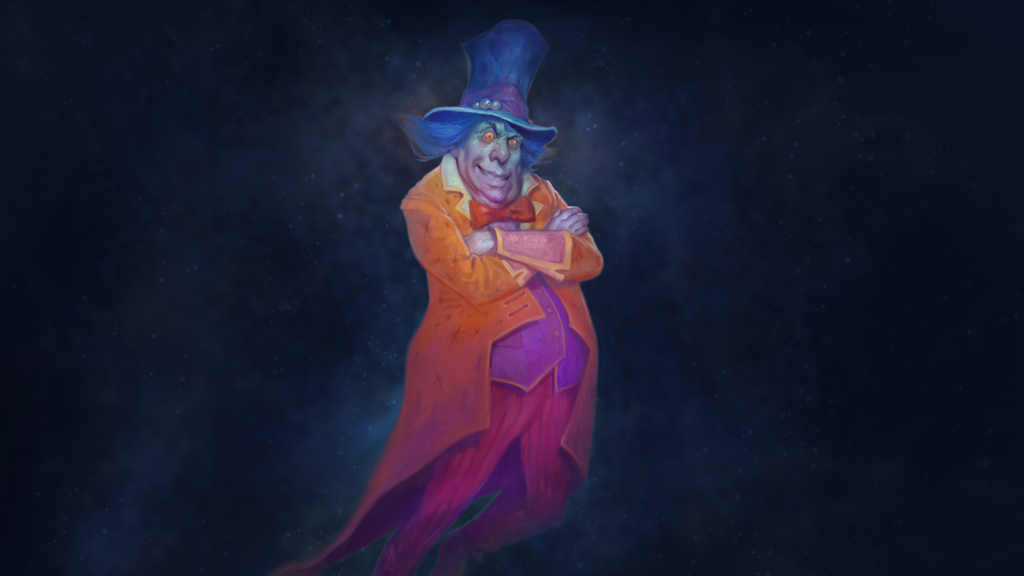
Before you say anything, we know: Peeves is not a ghost.
That has to be said clearly, because he is often grouped with the ghosts of Hogwarts, and even official features sometimes include him as a “bonus” alongside them. But Peeves is a poltergeist, which is a different kind of spirit. He was never a living witch or wizard who died and returned as an imprint.
Official Wizarding World writing describes Peeves as the most notorious and troublesome poltergeist in British history. In a castle full of young witches and wizards, a being like Peeves was almost inevitable: all that magical adolescence, anxiety, rebellion and noise gathering into one indestructible menace.
Unlike most poltergeists, Peeves has a physical form, though he can become invisible. That makes him especially difficult. Ghosts can be chilly and annoying, but Peeves can throw things. He smashes vases, topples bookcases, upends potions and lives to irritate whoever happens to be caretaker. Argus Filch’s hatred of him is one of the few things about Filch that feels completely reasonable.
Peeves also has a long institutional history. Official writing says he has been a problem for Hogwarts caretakers from the time of Hankerton Humble, who was appointed by the four founders. Attempts to remove Peeves have gone badly. One particularly disastrous effort in the 19th century reportedly caused enough damage that the school had to be evacuated.
But Peeves is not just random comic disruption. He understands the castle’s social order better than he pretends. He fears the Bloody Baron. He torments authority figures. He targets weakness. And, crucially, he joins the defenders of Hogwarts during the final battle.
Peeves may be a poltergeist, but he is Hogwarts’s poltergeist. When the school itself is threatened, his menace turns outward. He drops Snargaluff pods on Death Eaters and later celebrates Voldemort’s defeat in song. His loyalty is anarchic, but it is still loyalty.
So no, he is not a ghost. But any complete guide to Hogwarts hauntings has to include him, if only because Peeves would absolutely throw ink bottles at us if we didn’t.
Sir Patrick Delaney-Podmore
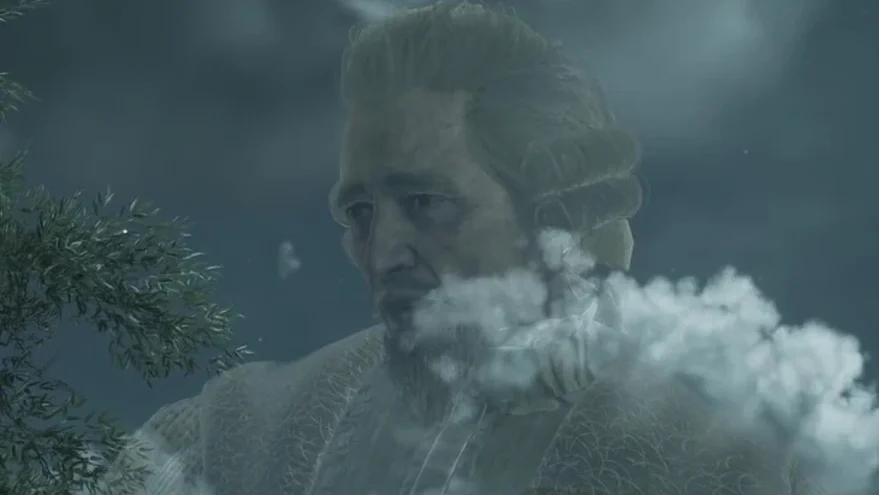
Sir Patrick Delaney-Podmore is not a Hogwarts house ghost, but he gives us one of the clearest glimpses into ghost society beyond the castle.
He is the leader of the Headless Hunt, an organization of ghosts who have been fully beheaded. That requirement is the source of Nearly Headless Nick’s great frustration. Nick wants to join, but because his head remains partially attached, Sir Patrick rejects him.
The Headless Hunt appears at Nick’s deathday party in Chamber of Secrets, turning the event from macabre to socially humiliating. Sir Patrick and his companions play Head Hockey, riding horses and tossing their heads around in a display that is both grotesque and oddly aristocratic. They represent a more flamboyant, exclusive branch of ghost culture, one where death’s disfigurements become the basis for status.
The Wailing Widow
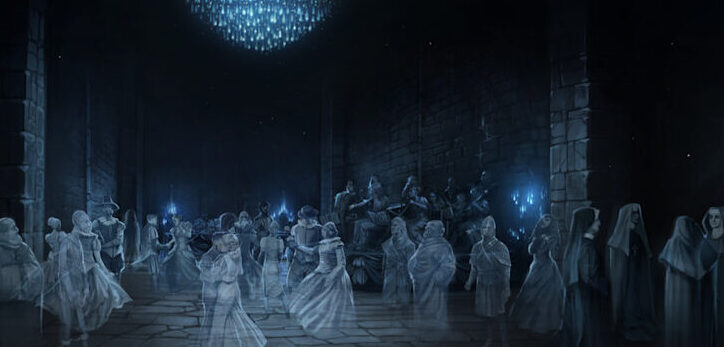
The Wailing Widow appears among the ghosts who attend Nearly Headless Nick’s deathday party, and while she is not as developed as the major Hogwarts spirits, her name alone does a lot of work.
She belongs to the wider ghostly community that gathers beneath Hogwarts on Halloween 1992, helping establish that ghosts have networks beyond their usual haunting places. Deathday parties are social events, complete with guests, music, “food” and all the uncomfortable etiquette of a living-world reception.
Ready to start the Harry Potter full-cast audiobooks?
$0.99/month for 3 months then $8.99/month
The Gloomy Nuns
The gloomy nuns are another group seen at Nick’s deathday party, adding even more to the medieval, ecclesiastical strangeness of the ghostly gathering.
They are easy to pass over, but they help broaden the world around Hogwarts’s better-known spirits. The ghosts we spend the most time with are tied to the school, but the deathday party suggests a much larger culture of magical dead, including religious figures, nobles, hunters, knights and mourners from different periods of British history.
The Knight With an Arrow Through His Forehead
The knight with an arrow through his forehead is one of the more visually memorable minor ghosts associated with Nick’s deathday party. Like many ghosts in the series, his appearance preserves the circumstances of death. A beheaded ghost remains beheaded. A bloodstained ghost remains bloodstained. A knight killed by an arrow keeps the arrow.
For a series that often makes death either heroic or mysterious, these minor ghosts keep it bodily and strange.
The Ragged Man Wearing Chains
The ragged man wearing chains, another ghost listed among the deathday party crowd, echoes some of the same imagery associated with the Bloody Baron: guilt, punishment and imprisonment made visible.
We do not get his story, but the chains suggest a life or death marked by captivity, crime, penance or suffering. His presence also shows how Harry’s world is full of stories we never fully receive. The series gives us just enough detail to make the imagination start working: Who was he? Why chains? Was he punished, guilty, innocent, condemned? Hogwarts is full of these things, and the ghosts are some of the best examples.
The Portly Ghost
The portly ghost is another minor figure connected to Nick’s deathday party, notable less for plot importance than for how he contributes to the social texture of the scene.
The deathday party is a room of distinct silhouettes: gloomy nuns, a wailing widow, a knight with an arrow, ragged figures, headless hunters, ghostly musicians and guests defined by centuries of odd death. The portly ghost is part of that visual comedy.
Harry Potter’s ghosts are often described in broad strokes because that is how Harry experiences them: quick impressions in the middle of discomfort, fear or confusion. But those impressions make the wizarding world feel old.
The Ghost Band
Nick’s deathday party includes a ghostly orchestra, and it may be one of the most underrated bits of world-building in Chamber of Secrets.
Music, like food, works differently for ghosts. The party’s rotten banquet exists because ghosts can almost taste decay by passing through it. The band suggests that art, performance and ceremony still matter after death, even if physical pleasures are gone. Ghosts may not eat in the ordinary sense, but they still gather. They still mark anniversaries. They still connect with each other.
The ghost band also adds to the scene’s uncomfortable humor. Harry, Ron and Hermione enter expecting something strange and find an entire culture with its own rules. The living are the outsiders. For once, Hogwarts is not built around student experience.
The Hogwarts Ghosts That Almost Were
Some of the most fascinating Hogwarts ghosts never made it into the final books.
Official Wizarding World writing notes that an early list of Hogwarts ghosts included Myrtle, initially called “Wailing Wanda,” Professor Binns, the Gray Lady) then called “the Whispering Lady”) and the Bloody Baron. It also included a Black Knight, the Toad and a ghost named Edmund Grubb.
Edmund Grubb is one we wish we could have seen. The notes described him as a fat Victorian ghost who expired in the doorway of the Dining Hall and sometimes stopped people getting in or out. We lost a masterpiece of petty haunting there.
The Toad is another wonderfully odd discarded idea, especially because it apparently left ectoplasm all over its classroom. The Black Knight, meanwhile, sounds like they could have expanded Hogwarts’s medieval atmosphere.
Why Hogwarts Has So Many Ghosts
Official Wizarding World writing calls Hogwarts the most heavily haunted dwelling place in Britain, and that makes sense on several levels.
First, the castle is old. Very old. It has seen generations of magical children, teachers, conflicts, secrets and accidents. Any building that has operated for roughly a thousand years is bound to collect stories. Hogwarts collects them literally.
Second, Hogwarts is emotionally intense. Students arrive at 11, form lifelong identities, face danger, fall in love, suffer humiliation, compete for houses, uncover mysteries and sometimes fight wars. For witches and wizards with unfinished business, Hogwarts offers an unusually powerful anchor.
Third, the living at Hogwarts tolerate the dead. The official explanation emphasizes that ghosts find the castle congenial because its inhabitants treat them with affection and patience, even when they repeat the same stories. A haunting requires not only a ghost but a place that can be haunted.
Finally, Hogwarts is a school, and ghosts are teachers whether they mean to be or not.
Nick teaches Harry that fearing death can trap a person in a shadow version of life. Myrtle teaches us that ignored victims do not simply disappear. Helena teaches the danger of secrets and the long reach of shame. The Baron teaches the horror of violence disguised as love. The Fat Friar teaches that kindness can survive death, though old resentments may survive with it. Binns teaches, perhaps accidentally, that history without meaning becomes lifeless.
Peeves, not a ghost but impossible to ignore, teaches that some institutions generate their own madness and then have to live with it.
The ghosts of Hogwarts are funny because the series is funny. They are eerie because a haunted castle should be eerie. But they endure because they turn the school into a place where the past is never past. It glides through the walls, interrupts dinner, cries in the bathroom, drones through class and waits, sometimes for centuries, for someone living to ask the right question.
About MuggleNet: MuggleNet has covered the Wizarding World since 1999, offering news, guides, editorials and fan resources for readers around the world.
Ready to start the Harry Potter full-cast audiobooks?
$0.99/month for 3 months then $8.99/month
Hogwarts Ghosts FAQ
From Nearly Headless Nick to Moaning Myrtle, the ghosts of Hogwarts are more than castle atmosphere. They carry old fears, unfinished stories and centuries of magical history through the walls.
What is a ghost in the Harry Potter series?
In the wizarding world, a ghost is the transparent imprint of a deceased witch or wizard who chose to remain behind rather than move on. Ghosts are not fully alive again, and they do not have complete knowledge of what happens after death.
Who are the four Hogwarts house ghosts?
Gryffindor’s ghost is Nearly Headless Nick, Hufflepuff’s is the Fat Friar, Ravenclaw’s is the Gray Lady and Slytherin’s is the Bloody Baron. Each ghost reflects part of their house’s history, values or darker complications.
Is Peeves a ghost?
No. Peeves is a poltergeist, not a ghost. Unlike Hogwarts ghosts, he was never a living witch or wizard who died and left an imprint behind. He is a chaotic spirit tied to the castle’s noise, mischief and magical energy.
Why is Nearly Headless Nick called Nearly Headless Nick?
Nearly Headless Nick, whose full name is Sir Nicholas de Mimsy-Porpington, was executed in 1492, but the beheading was badly botched. His head remains attached by a small flap, which is why he is “nearly” headless rather than fully headless.
Who is the Gray Lady?
The Gray Lady is Helena Ravenclaw, daughter of Hogwarts founder Rowena Ravenclaw. She stole her mother’s diadem, hid it in Albania and was later killed by the man who became the Bloody Baron.
Why is Moaning Myrtle important?
Moaning Myrtle was a Ravenclaw student named Myrtle Elizabeth Warren. She was killed by the Basilisk when Tom Riddle opened the Chamber of Secrets, making her death one of the earliest known murders in his path toward becoming Voldemort.
Can ghosts at Hogwarts die again?
Ghosts cannot die a second time in the ordinary sense. In Chamber of Secrets, Nearly Headless Nick is petrified when the Basilisk’s gaze reaches him indirectly, but he is not killed because he is already dead.
Why does Hogwarts have so many ghosts?
Hogwarts is ancient, emotionally intense and unusually welcoming to the dead. The castle has held generations of magical students, teachers, secrets and conflicts, making it a natural home for spirits with unfinished business.
Images: Warner Brothers Discovery