

- By MuggleNet Editorial Staff
- 17 May, 2026
Tucked into the north end of Diagon Alley, a snow-white marble building looms over every other storefront in sight. Burnished bronze doors. A scarlet-and-gold-uniformed goblin standing watch. A second set of silver doors engraved with a warning poem that has unsettled first-time visitors for centuries. This is Gringotts Wizarding Bank and according to Rubeus Hagrid, “yeh’d be mad ter try and rob it.”
Here is a complete guide to the bank’s history, security, and curses.

A Bank Built by Goblins
Gringotts was founded in 1474 and the institution has been run by goblins ever since. The name itself is widely believed to be a portmanteau of “grind” and “ingots,” which could be a reference to the metalwork and currency-minting that goblins are known for.
Goblins produce a significant portion of wizarding money. They also handle currency exchange for Muggle parents like the Grangers, with the converted money eventually returned to circulation aboveground.
The bank’s relationship with the wizarding community has always been uneasy. Goblins operate under a strict internal code that forbids them from disclosing the bank’s secrets, and they consider any breach “base treachery”. Griphook spells out the underlying tension during the events of Deathly Hallows, noting how deeply goblins resent “wand-bearer” interference. That resentment helps explain why so much of Gringotts’ inner workings remain unknown even to the wizards who keep their fortunes there.
The Building Itself
The entrance is meant to capture your attention. A short flight of white stairs leads to those bronze doors, then to a small antechamber, then to silver doors carrying the engraved warning: “Enter, stranger, but take heed / Of what awaits the sin of greed…Thief, you have been warned, beware / Of finding more than treasure there”.
Beyond the silver doors stretches a marble hall lined with counters. Harry estimated more than 100 goblins working there during his first visit, weighing coins, examining gemstones and stamping ledgers. The Warner Bros.Studio Tour London, which now houses an authentic Gringotts set, notes that the prop department produced more than 210,000 coins for the final two films, and 38,000 pieces of rubberized treasure for the Lestrange vault sequence, including 7,014 Hufflepuff Cups.
Vaults and the World Below
The bank’s vault network extends for miles beneath London, accessed by goblin-operated mining carts that rocket along winding rails. Only goblins can drive the carts, and they move so quickly that passengers have no real chance to memorize the route.
Vaults are tiered by security. Lower-security vaults, like the Weasleys’ nearly empty one or Harry’s trust vault, open with a simple key. Higher-security vaults require a goblin to press a finger to the door; if anyone else attempted it, according to Griphook, they would be “sucked in the door and trapped in there”. Vault 713, where Nicolas Flamel briefly stored the Philosopher’s Stone, falls into this category. The deepest vaults, those of the oldest pure-blood families, including the Lestranges, require a full palm pressed to the door and are guarded by curses far more dangerous.
Layered Security
Gringotts’ reputation of safety rests on overlapping defenses. Probity Probes, slender instruments that detect concealment charms, and hidden objects, are sometimes used at the entrance. During the Second Wizarding War, when Voldemort’s regime tightened its grip on the bank, Probity Probes became standard, the goblin doormen were replaced with wizard guards, and an ordinary withdrawal could reportedly take five hours.
A full-time security force responds to alarms inside the bank. Sphinxes have been used at various points to guard high-security vaults, posing riddles to anyone seeking entry. Anti-Summoning enchantments mean no one can simply Accio a Galleon out of a vault from the surface.
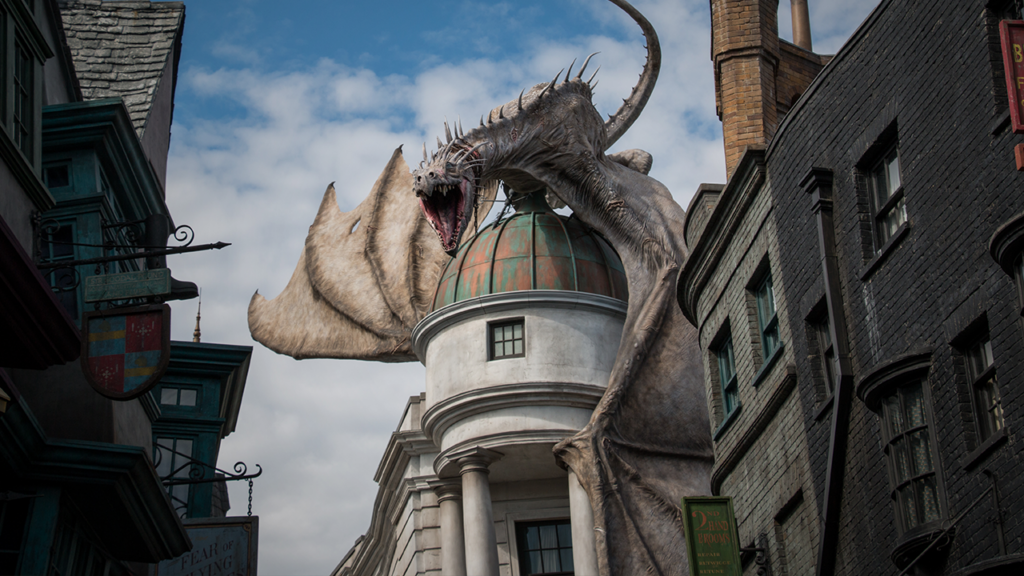
Then there are the dragons. Though dismissed as rumor in the wizarding press, they are real. The half-blind Ukrainian Ironbelly chained outside the Lestrange vault is the most famous example. Goblins control these creatures with instruments called Clankers, which produce a sound the dragons have been conditioned (though pain) to fear. It is a deeply cruel system, one Hermione visibly recoils from during the 1998 break-in.
The Curses
The most lethal layer is the curse work.
The Gemino Curse causes any object touched by an intruder to multiply rapidly. Touch one goblet and you get two; touch those and you get four. Within seconds, a vault floor can become a rising tide of duplicates. The Flagrante Curse layers on top, causing those same objects to burn searingly hot the moment they make contact with skin. Together, the two curses are designed to crush and scorch a thief beneath an avalanche of multiplying, red-hot treasure.
The Thief’s Downfall is another curse, though one that is admittedly more beautiful. It appears as a waterfall cascading directly across the cart tracks deep underground. Anything passing through has every concealing enchantment stripped away, Polyjuice Potion, Transfiguration, the Imperius Curse, even ordinary Invisibility Cloaks (the Cloak of Invisibility, being a Deathly Hallow, is an exception). The waterfall also derails the cart, leaving would-be thieves stranded with no idea how to get out.
Two Break-Ins, Seven Years Apart
Only two break-ins are known. The first, on July 31, 1991, was committed by Quirinus Quirrell on Voldemort’s orders. It failed, as Hagrid had emptied Vault 713 hours earlier. The second, on May 1, 1998, succeeded. Harry, Ron, Hermione, and Griphook stole Helga Hufflepuff’s Cup from the Lestrange vault and escaped on the back of the chained dragon, leaving the lobby in ruins.
It was the first successful theft in the bank’s 524-year history. The goblins, presumably, have since reinforced everything.