

- By MuggleNet Editorial Staff
- 17 May, 2026
When Harry Potter and the Cursed Child premiered at London’s Palace Theatre on June 7, 2016, it arrived as a five-hour, two-part experience that asked audiences to commit to either a marathon day at the theater or two separate evenings out. Ten years later, the play looks remarkably different. It has been condensed, restructured, rewritten and, in some productions, reimagined to nudge a long-suspected connection into the open. With Tom Felton currently reprising his role as Draco Malfoy on Broadway, and the West End preparing to retire its original two-part staging this fall, now is a good moment to take stock of what Cursed Child actually is, and how much it has changed.

The Story, in Brief
Cursed Child picks up where the Deathly Hallows epilogue left off, 19 years after the Battle of Hogwarts. Harry is the Head of Magical Law Enforcement, Hermione is Minister for Magic, Ron runs Weasleys’ Wizard Wheezes with George, and Ginny edits the sports section of the Daily Prophet. Their middle child, Albus Severus Potter, boards the Hogwarts Express dreading a sorting his father told him not to fear. On the train he meets Scorpius Malfoy, Draco’s awkward and painfully sincere son. Both boys (surprise!) end up in Slytherin. Both are bullied: Albus for failing to live up to the Potter name, Scorpius for the persistent rumor that he is secretly Voldemort’s son.
By the start of fourth year, Albus and Harry can barely speak without arguing. After Amos Diggory comes to the Ministry begging Harry to use an illegal Time-Turner (with new, dangerous magical capabilities) to save Cedric, Albus decides to do it himself. With Scorpius and Amos’s mysterious “niece” Delphi, he steals the Time-Turner and travels back to the Triwizard Tournament. The boys’ meddling cascades into a series of broken timelines, including a dystopia in which Voldemort won, and Scorpius is the only person who remembers the world as it should be.
The villain reveal is a shocking moment: Delphi is Voldemort and Bellatrix Lestrange’s daughter, raised in secret and bent on resurrecting her father. The story climaxes at Godric’s Hollow on the night the Potters die, with Harry transfiguring into Voldemort to trick Delphi while his parents are murdered across the road. Albus and Harry end at Cedric’s grave, beginning, finally, to understand each other. (For a more thorough scene-by-scene breakdown of the original storyline, LitCharts has a useful one.)
That’s the spine of the play and it’s mostly stayed the same. What’s been built around it has shifted considerably.
The Original Two-Part Production
In its original West End form, Cursed Child ran roughly five hours and 15 minutes across two parts, each with two acts. The runtime allowed for a sprawling, generous production with extensive flashbacks to Harry’s childhood, full scenes with talking portraits, and a number of indulgent set pieces.
One of the most memorable sequences was set at St. Oswald’s Home for Old Witches and Wizards, where Amos Diggory lived. Reviewers and audience members frequently singled out the scene’s background gags and illusions as a highlight, including, as one blogger described, a wizard pulling a “seemingly everlasting piece of string out of his mouth” while the main action played out front.
The original production also gave stage time to the centaur Bane, who delivers a foreboding warning that a “dark cloud” surrounds Albus, a moment that drives Harry’s panicked attempt to separate Albus from Scorpius. Polly Chapman, a Hogwarts classmate, had her own subplot, including a running joke of being asked to the school ball. Lily Potter Jr., Albus’s younger sister, appeared on stage. So did young Harry, in a series of dream sequences.
The play also famously hedged on the relationship at its emotional center. Albus and Scorpius’s bond was written and staged with such intensity that many fans interpreted it as a budding romance rather than platonic friendship. Still, in the original version, Scorpius spent considerable energy pining after Rose Granger-Weasley, and references to crushes on Delphi and Polly Chapman pinged through the script.
The First Big Rewrite: One Part, 2021
When Broadway theaters reopened after the COVID-19 pandemic, Cursed Child came back in November 2021 as a single, condensed three-and-a-half-hour show. Playwright Jack Thorne and director John Tiffany used the lockdown to substantially rework the script, and the cuts were significant.
Out went the dream sequences with young Harry, the Dursleys, and Hagrid. Out went Scorpius’s extended conversations with Polly Chapman and Draco in the Voldemort-ruled timeline. The St. Oswald’s old folks’ home was replaced with a scene set at Amos Diggory’s private residence. Lily Potter Jr. was cut and reduced to a passing mention. Every role in the new version was played by an adult. The talking-portrait scenes were trimmed or dropped.
More notable than what was cut was what was added and shifted. The one-part version reframed Albus and Scorpius’s relationship as more directly romantic. Rose became a platonic friend rather than a love interest, almost all the girlfriend-related dialogue was removed, and Delphi, while torturing Scorpius, refers to Albus’ weakness for him as “love” rather than “friendship.” A new scene was added in which Albus tells Harry, at Cedric’s grave, that Scorpius will always be the most important person in his life. Harry responds warmly, registering as a quiet moment of paternal acceptance.
These changes were initially limited to the North American one-part version, but they have since spread. All productions except London eventually used the one-part script. London, which remained two parts, adapted the changes to Albus and Scorpius’ dynamic and removed St. Oswalds, but kept many of the other scenes.
The Second Rewrite: Under Three Hours, 2024
In September 2024, Cursed Child launched its first North American tour in Chicago with an even leaner version, clocking in at about two hours and 50 minutes, roughly 40 minutes shorter than the 2021 cut. On November 12, 2024, that version replaced the longer one on Broadway as well.
Reviewers who had seen earlier iterations noted further trimming around the edges. The Guardian’s review of the shorter version observed that some characters had been dropped entirely. The Guardian also noted that one major secret-villain character is now barely on stage at all, a reference to Delphi. Bane the centaur, whose ominous warnings drove a substantial subplot in the original, has been removed from this version as well.
A High School and Secondary School Edition, also released in 2024 through Broadway Licensing, is now available for school productions.
What’s Still Out There
Until recently, the West End and Hamburg were the last holdouts performing the original four-act, two-part script. Hamburg switched to the one-part version on February 9, 2023. London held on the longest, but on October 6, 2026, the Palace Theatre will reopen with the under-three-hour version that’s currently running on Broadway, ending the original staging’s 10-year run on September 20.
The original two-part script is still in print as both the 2016 Special Rehearsal Edition and the 2017 Definitive Collector’s Edition, so the original can still be read even though it’s no longer being staged anywhere in the world.
Why It Matters
Cursed Child has always sat in an awkward spot in the larger Harry Potter story. J.K. Rowling has called it canon. A vocal contingent of fans have refused to accept it as such, citing its new time-travel mechanics, its handling of Delphi’s lineage, and a general sense that the script feels different to the books. The play’s evolution does little to settle that argument, but it does suggest something interesting about how a piece of theater can keep talking back to its audience.
The 2021 and 2024 revisions were not just about fitting modern attention spans or making the show more tour-friendly, although both played a role. The shift in Albus and Scorpius’s relationship in particular reads as a direct response to feedback that the original production wrote a love story and then refused to call it one. The changes amount to the creative team revisiting a choice they got pushback on the first time and correcting it.
Whether you read Cursed Child as canon, a tourist event, elaborate stagecraft, or just a fun night out, the version of the play being performed today is significantly different from the one that opened in 2016. If you saw it in its original form a decade ago and have been wondering whether it’s worth seeing again, that may be reason enough to give it another look.
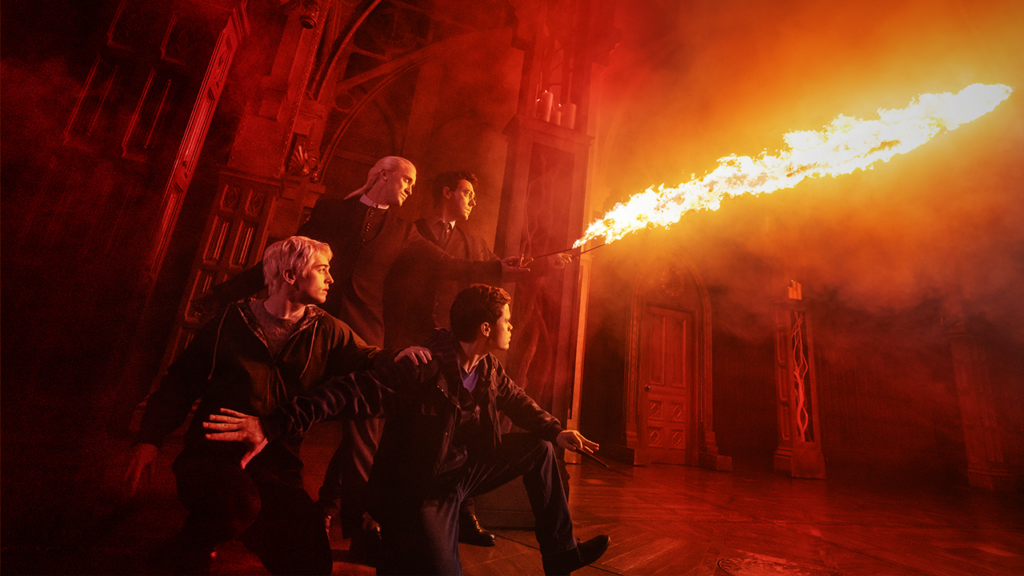
Photo courtesy of Harry Potter and the Cursed Child
About MuggleNet: MuggleNet has covered the Wizarding World since 1999, offering news, guides, editorials and fan resources for readers around the world.
Last Updated: May 25, 2026